Machine transcription is reliable for research interview data as a first-pass draft, not as the final transcript researchers quote or code from. Automatic speech recognition (ASR) handles clean, single-speaker audio well in 2026, but accuracy drops on cross-talk, accents, and field-specific jargon — exactly the conditions common in qualitative interviews — so a human review pass still decides whether the transcript is analysis-ready.
TL;DR
- Machine transcription is reliable for research interviews as a first draft, not for direct quotation without a human proofread.
- Speaker diarization and accent handling are the two biggest accuracy variables in interview audio.
- Full verbatim, not clean verbatim, is the standard most qualitative coding schemes require.
- An ASR draft plus one proofreading pass against the audio is faster than full manual transcription and more defensible than ASR alone.
Why this matters
Qualitative coding schemes — thematic analysis, grounded theory, discourse analysis — depend on the exact words a participant used. An error that swaps 'not' for 'now,' or merges two speakers into one turn, changes the unit of analysis, not just the spelling. Human proofreading after an AI transcript is the step that separates a usable research transcript from a rough draft, and it's the step most turnaround-time comparisons skip when they cite ASR speed alone.
Data handling matters too. Interview recordings often carry identifiable participant information, so IRB-approved studies need a transcription workflow with a clear proofreading step, not just a fast one. A tool that turns the raw ASR draft into a timed, diarized transcript you can check against the audio is what makes that proofreading pass fast instead of a full retype.
Is machine transcription reliable for research interviews?
Reliable enough to start with, not reliable enough to finish with. ASR output on a quiet, single-speaker recording routinely matches a human transcriber on common words, but qualitative interviews are rarely quiet or single-speaker — participants interrupt, trail off, and switch topics mid-sentence, and that's where automatic transcripts need a second pass.
| Method |
Best for |
Speaker labels |
Ready to code or quote from |
| ASR-only, no edit |
Quick skim, initial coding pass |
Auto-detected, often mislabeled on overlap |
No |
| ASR + human proofread |
Most qualitative research interviews |
Auto-detected, then renamed and verified |
Yes |
| Full manual transcription |
High-stakes legal or clinical interviews |
Manually assigned from the start |
Yes |
ASR plus a human proofread is the reliable path for research interview data in 2026 — it keeps the speed of automatic transcription and adds the accuracy check qualitative coding requires.
Full verbatim: the standard most qualitative coding needs
Full verbatim transcription keeps every filler word, false start, and repetition exactly as spoken — 'um,' 'you know,' 'I- I mean.' Most coding schemes in discourse analysis and conversation analysis need this level of detail because hesitations and self-corrections are data, not noise. An ASR draft captures most of this automatically; a human pass confirms the fillers weren't dropped during cleanup.
Clean verbatim: when it's acceptable
Clean verbatim removes fillers, false starts, and repeated words to produce readable prose. It's acceptable for research that only needs the content of what was said — executive summaries, stakeholder interviews used for reporting rather than linguistic analysis. It is not acceptable for any coding scheme that treats hesitation or phrasing as meaningful data.
Speaker diarization: the other accuracy variable
Diarization is the process of detecting how many speakers are in a recording and labeling who said what. Two-person interviews with distinct voices diarize well; focus groups with three or more speakers talking over each other diarize worse, and mislabeled turns are one of the most common errors researchers catch during proofreading. Speaker labels generated automatically can be renamed and corrected in the editor before the transcript goes to a coder, which is faster than retyping the whole turn structure by hand.
Why transcription accuracy varies across interviews
- Audio quality — a lapel mic close to the participant outperforms a laptop's built-in mic across a conference table.
- Number of speakers and cross-talk — one-on-one interviews diarize and transcribe more accurately than group interviews with overlapping speech.
- Accent and dialect — ASR accuracy on accented English varies by model and training data; strong regional or non-native accents raise the error rate a researcher needs to catch in review.
- Domain-specific vocabulary — clinical, legal, and technical terms outside everyday speech get misheard more often than common words.
- Code-switching — interviews that move between two languages mid-sentence need a transcription workflow that supports that, not just single-language ASR.
- Recording length — a 90-minute interview gives more opportunity for audio drift (mic distance, background noise change, battery) than a 20-minute one.
How to turn an AI transcript into a research-ready one
- Upload the interview recording and run ASR transcription with timed segments.
- Run speaker diarization and rename labels to participant IDs or pseudonyms.
- Proofread against the audio, correcting misheard words, especially jargon and names.
- Decide verbatim style — full verbatim for discourse or conversation analysis, clean verbatim for content summaries — and apply it consistently across every transcript in the study.
- Export in the format your coding software expects. VideoText's transcript editor lets you fix wording before export, so the correction happens once, not once in the AI draft and again inside your coding tool.
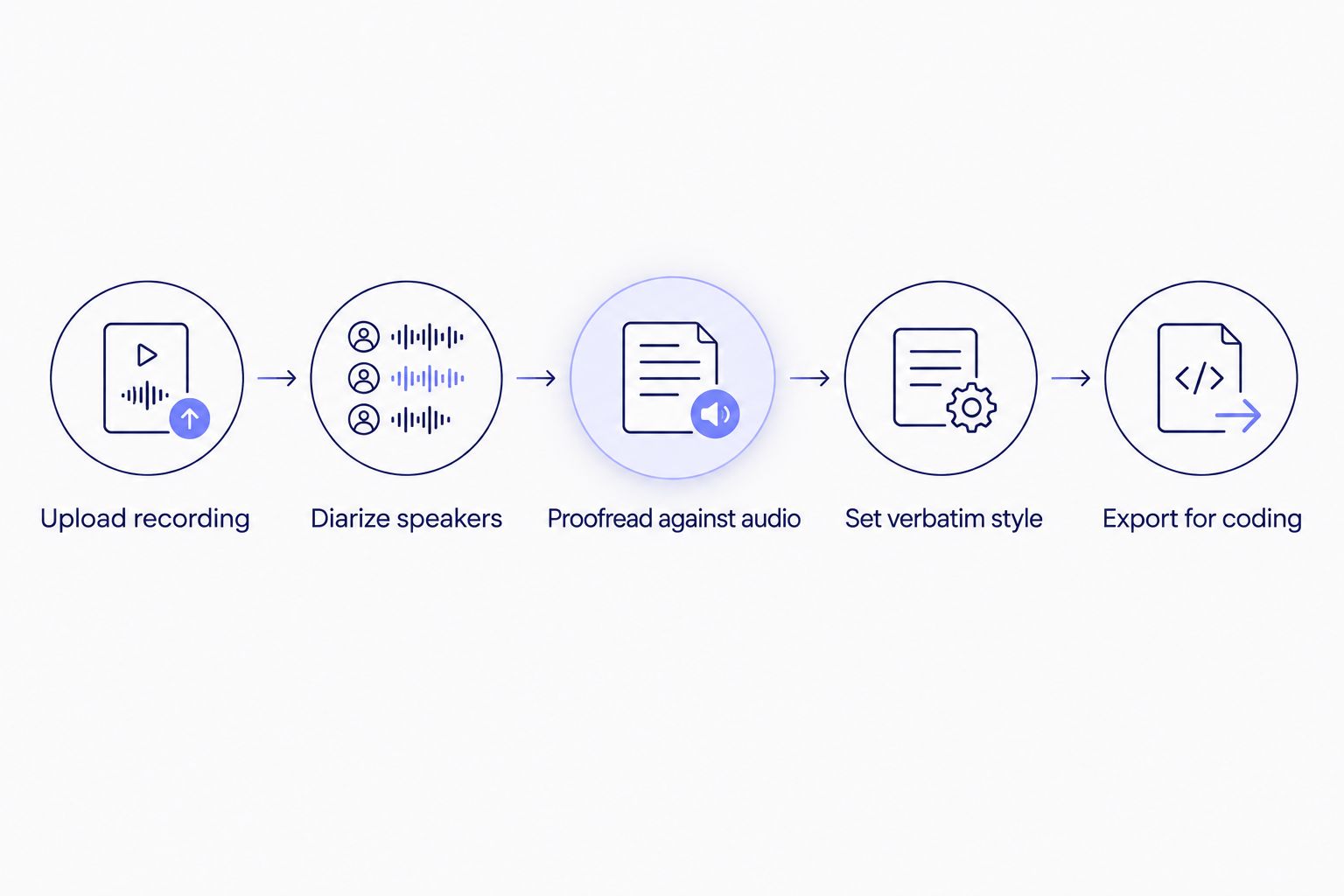
The proofread step against the audio is what makes a transcript defensible for coding.
Get interview transcripts ready to code
Transcribe, diarize, and edit before export in one pass.
Start transcribing
Do I need to proofread AI-generated interview transcripts before coding them?
Yes. Proofreading against the audio catches the errors ASR makes most often on interview data: misheard jargon, merged speaker turns, and dropped fillers when full verbatim is required. Skipping this step risks coding decisions based on words the participant didn't actually say.
Can AI transcription handle multiple speakers in a research interview?
Automatic speech recognition can diarize and label multiple speakers, but accuracy depends on how much they overlap. Two people taking clean turns transcribes and diarizes well; three or more people talking over each other needs a manual check on every speaker change before the transcript is usable for coding.
Is full verbatim or clean verbatim better for qualitative research?
Full verbatim is better for qualitative research that treats hesitations, false starts, and filler words as data, which covers most discourse and conversation analysis. Clean verbatim only works when the study needs the content of the interview, not the exact way it was spoken.
FAQ
Is AI transcription accurate enough for academic research interviews?
AI transcription is accurate enough as a first draft for academic research interviews, but it needs a human proofread against the audio before it's used for coding or direct quotation in 2026.
What's the difference between full verbatim and clean verbatim for research transcripts?
Full verbatim keeps every filler, false start, and repetition exactly as spoken; clean verbatim removes them for readability. Most qualitative coding schemes require full verbatim.
Do research interview transcripts need speaker labels?
Yes, any interview with more than one speaker needs speaker labels so quotes and coded segments can be attributed correctly. Automatic diarization labels speakers first; a researcher renames and verifies them.
Can machine transcription handle accented English in interviews?
Machine transcription handles accented English with variable accuracy depending on the model and the strength of the accent, which is why accented interview audio needs closer proofreading than a clear, native-accent recording.
How do you make an AI transcript ready for qualitative coding?
Diarize the speakers, proofread every line against the audio, apply a consistent verbatim style across the whole study, then export into the format your coding software accepts.
Is machine transcription secure enough for sensitive research data?
Security depends on the vendor's data handling policy, not on the transcription method itself. IRB-approved studies should confirm retention and access controls before uploading identifiable interview audio.
Should IRB-approved studies use automatic transcription?
IRB-approved studies can use automatic transcription for the first draft, provided a researcher proofreads the output against the audio and the platform's data handling policy fits the study's consent terms.
One last thing
The transcription errors that hurt research the most aren't misspelled words — they're merged turns and mislabeled speakers, because those change who said what in a quoted excerpt. Check speaker boundaries before you check spelling; it catches more coding-breaking errors per minute of review than a word-by-word read.
Related guides