Live transcription can support broadcast captions in 2026, but raw ASR output is not a safe broadcast-ready default. It needs clean audio, controlled speaker handoffs, output monitoring, and human correction when accuracy, synchronization, completeness, and placement are compliance requirements. Pre-recorded segments should use batch transcription and subtitle QA instead of the live pipeline.
TL;DR
- Live transcription is not accurate enough for broadcast when raw ASR goes directly to air without monitoring or correction.
- FCC caption quality covers accuracy, synchronization, completeness, and placement rather than one universal accuracy percentage.
- Live ASR performs best with clean audio, one active speaker, prepared terminology, and a human correction path.
- VideoText live transcription is best for creating a real-time draft, not replacing broadcast caption QA in 2026.
- Pre-recorded segments should use batch transcription, SRT or VTT generation, and a complete subtitle QA pass.
Is live transcription accurate enough for broadcast captions?
Live transcription is accurate enough only when the complete workflow controls its errors before they reach viewers. An unattended ASR feed does not provide that control. A monitored feed with clean audio, prepared terminology, and a trained editor correcting errors can support some broadcasts, but compliance cannot be assumed from the transcription engine alone.
VideoText provides live transcription as real-time streaming ASR. For broadcast work, treat that output as the first stage of the caption workflow. The final decision depends on how the feed handles recognition errors, speaker changes, caption delay, missing words, line breaks, and placement.
| Caption method |
Main strength |
Main limitation |
Best for |
Verdict |
| Unattended live ASR |
Produces text while speech is happening |
Recognition and formatting errors can reach viewers immediately |
Internal monitoring and rough live drafts |
Skip for compliance-critical delivery |
| Monitored live ASR |
Combines machine speed with human correction |
Requires trained staff and an operational fallback |
Controlled live streams and supervised broadcasts |
Use with documented QA |
| Human stenocaptioning or respeaking |
Gives a trained operator direct control over live corrections |
Human performance and source-audio quality still affect output |
Live news, public affairs, sports, and emergency coverage |
Use for high-risk live programming |
| Batch ASR with subtitle QA |
Uses the full recording before captions are finalized |
Cannot caption material that is genuinely live |
Taped packages, delayed segments, and on-demand versions |
Use for pre-recorded content |
Raw word accuracy is only one part of the decision. A transcript can contain the right words and still fail as broadcast captions because cues appear late, disappear too quickly, cover important graphics, omit speakers, or split sentences into unreadable lines.
Word error rate, or WER, measures substitutions, deletions, and insertions against a reference transcript. WER helps compare recognition output, but it does not measure every caption-quality requirement. It does not tell you whether captions are synchronized, complete, positioned correctly, or formatted for the client’s delivery specification.
Why broadcast caption accuracy matters
FCC caption quality rules in 47 CFR 79.1 evaluate four areas: accuracy, synchronicity, completeness, and placement. The rule does not set one universal percentage that makes every live caption feed compliant. The program type, production conditions, caption method, and handling of errors all matter.
That distinction is critical in 2026. A vendor can report strong ASR recognition while the delivered captions still fail because a sentence arrives after the speaker has moved on. A feed can also miss non-speech information, drop a remote guest during connection loss, or place text over names and emergency information.
Internet video has a separate regulatory scope. FCC requirements for certain video programming delivered over IP appear in 47 CFR 79.4, including programming previously shown on television with captions, subject to the rule’s coverage and exemptions. A webcast, television simulcast, and on-demand clip do not automatically carry identical obligations, so the delivery specification must identify the platform and program type.
For an editor, the practical rule is simple: do not use a recognition score as the sole acceptance test. Review the rendered captions against the program, the applicable rules, and the client’s written guideline.
A broadcast-safe live caption workflow
A reliable workflow separates audio preparation, recognition, correction, rendering, and monitoring. Each stage catches a different failure type.
1. Prepare a clean program feed
Send the captioning system a direct mix rather than audio captured from room speakers. Balance remote contributors before the feed reaches ASR. Avoid background music under speech when the production allows it, and prevent several open microphones from carrying the same voice with different delays.
Clean audio does not guarantee correct text. It removes avoidable recognition problems so the editor can focus on names, terminology, speaker changes, and context.
2. Prepare names and specialist terminology
Create a run-of-show list containing presenter names, guest names, locations, organizations, acronyms, and specialist terms. Give the list to the human captioner or load it into the workflow when the selected system supports vocabulary preparation.
This step matters because proper nouns are often impossible to infer from sound alone. Several spellings can be phonetically plausible, and live ASR cannot verify which spelling the producer intended without context.
3. Run live ASR as the draft layer
Stream the prepared audio into the recognition system and watch partial text separately from committed caption output when the workflow exposes both. Partial text can change as more speech arrives. Committed text is what the viewer receives, so the operator needs to know when corrections are still possible.
VideoText live transcription is best for teams that need a real-time text draft while retaining human responsibility for broadcast caption quality. It converts streaming speech to text, but the broadcast workflow still needs monitoring, correction, and an output path that matches the destination.
4. Correct names, omissions, and speaker changes
Assign an editor to monitor the live output against the program audio. Prioritize errors that change meaning: negation, numbers spoken on air, names, locations, warnings, and missing phrases. Correct speaker identification when the program requires labels or when a change would otherwise be unclear.
Multi-speaker production needs special attention. Speaker diarization identifies and separates speakers, but overlapping voices and rapid interruptions remain difficult. The guide to speaker diarization software explains how diarization differs from transcription and where manual speaker review remains necessary.
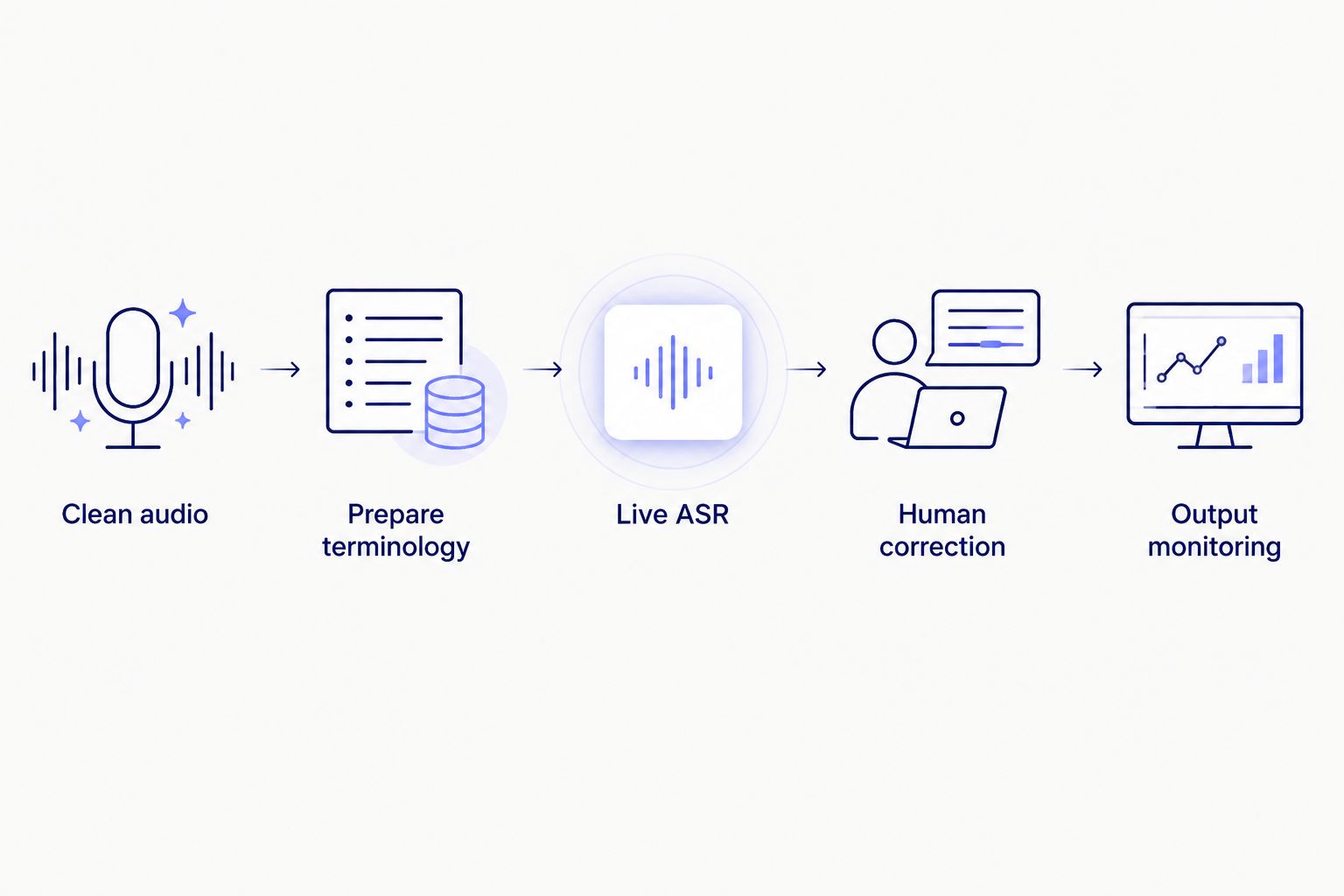
Recognition is one stage; correction and output monitoring remain separate controls.
5. Monitor the rendered output
Monitor the exact captions viewers receive, not only the transcript inside the editor. This catches transmission loss, encoding problems, missing cues, placement conflicts, and delay introduced after transcription.
Keep a fallback path for feed failure. The fallback can be a second caption source, a human operator, or a production procedure that preserves required information until caption service returns. The correct choice depends on the broadcast system and program requirements.
Create a live transcription draft
Stream speech to text, then keep human correction and output monitoring in the broadcast workflow.
Try VideoText
Why live transcription accuracy varies
Live accuracy changes with the program conditions. Evaluate the actual production feed rather than relying on a result from clean demonstration audio.
- Audio signal quality: Clipping, room echo, low levels, and connection artifacts remove information before ASR processes the speech.
- Speaker overlap: Simultaneous speech makes word boundaries and speaker attribution harder for both recognition and diarization.
- Language and accent coverage: Model performance varies across languages, regional accents, code-switching, and mixed-language programs.
- Terminology: Uncommon names, acronyms, product terms, and specialist vocabulary need preparation and correction.
- Latency settings: More context can improve recognition, but waiting for context delays the caption. The workflow has to balance correction time against synchronization.
- Human supervision: A trained operator can correct meaning-changing errors and trigger a fallback when the recognition or transmission path fails.
CPL and CPS are separate from recognition accuracy. CPL means characters per line. CPS means characters per second, a reading-speed measure based on the amount of text displayed during a cue. A live transcript can spell every word correctly while producing lines that are too dense, badly broken, or visible for too little time under the client’s guideline.
Do not apply one CPL or CPS limit to every project unless the delivery specification names it. Broadcasters, streaming platforms, accessibility teams, and caption vendors can use different formatting rules. The acceptance test must follow the destination’s documented requirement.
How should pre-recorded segments be captioned?
Pre-recorded segments should use batch transcription followed by subtitle editing and validation. Batch processing can use later speech to resolve earlier ambiguity, while the editor can replay unclear audio and verify names before delivery.
A practical 2026 workflow is:
- Upload the final media file rather than an early edit.
- Generate timed transcript segments and an SRT or VTT caption file.
- Check the transcript against the audio for substitutions, deletions, and insertions.
- Review cue timing, overlaps, gaps, line breaks, CPL, CPS, and scene-cut spans.
- Format the file to the broadcaster’s or client’s written guideline.
- Export the required caption format and inspect it against the final video.
VideoText supports this post-production path with timed transcription, SRT and VTT output, an in-browser cue editor, and checks for overlaps, CPL, CPS, gaps, timing drift, grammar, line breaks, and scene-cut spans. These controls are relevant to taped packages because the editor has time to fix the file before air.
Pre-recorded and live content should not share the same acceptance standard. Live captions are produced under real-time constraints. A taped segment has an editing window, so unresolved recognition errors, timing drift, and poor line breaks should be corrected before delivery in 2026.
Is human correction always required for live broadcast captions?
Human correction is required whenever the broadcaster’s risk assessment and delivery standard cannot accept unreviewed ASR errors. Compliance-critical programming needs a correction or stenocaptioning path because raw live transcription cannot guarantee all four FCC caption-quality areas.
Is live ASR better than stenocaptioning?
Live ASR is easier to automate, but stenocaptioning gives a trained operator direct control over wording, context, and correction. Neither method is immune to poor source audio, so the better choice is the one that meets the program’s accuracy, synchronization, completeness, placement, staffing, and fallback requirements.
Can live captions be corrected after broadcast?
Corrections can improve archived and on-demand versions, but they do not repair the captions viewers already received during the live program. Save the recording and caption output, correct the transcript, rerun subtitle QA, and publish a revised file for the on-demand version.
FAQ
Is live transcription accurate enough for broadcast in 2026?
Live transcription is accurate enough only when the complete workflow controls errors through clean audio, monitoring, correction, and a fallback path. Raw ASR should not go directly to air for compliance-critical programming.
Does the FCC require a specific caption accuracy percentage?
No. FCC rule 47 CFR 79.1 evaluates accuracy, synchronicity, completeness, and placement rather than setting one universal accuracy percentage for every broadcast.
What is word error rate in live transcription?
Word error rate measures substitutions, deletions, and insertions against a reference transcript. It does not measure caption timing, completeness, placement, or readability.
Why is batch transcription better for pre-recorded broadcasts?
Batch transcription can use the full recording as context before finalizing text. Editors can then replay unclear audio and fix wording, timing, CPL, CPS, and line breaks before air.
What causes errors in live broadcast captions?
Poor audio, overlapping speakers, uncommon names, specialist terminology, accents, connection loss, and limited correction time cause live caption errors. Several problems can occur in the same segment.
Can VideoText produce broadcast captions automatically?
VideoText can produce live transcription and generate timed SRT or VTT output from uploaded media. Broadcast delivery still requires review against the program, destination format, applicable rules, and client guideline.
Do live captions need speaker labels?
Speaker labels are needed when viewers cannot otherwise identify who is speaking or when the delivery guideline requires them. Diarization can create a draft assignment, but overlapping speech still needs review.
Should archived broadcasts keep the original live captions?
The archived version should use corrected captions when the workflow allows it. Recheck the recording, repair recognition and timing errors, and validate the final caption file before publication.
One last thing
Test the entire path before the 2026 broadcast: program audio, ASR input, correction interface, encoder, transmission, and viewer output. A clean transcript inside the editor does not prove that the audience received complete, synchronized, correctly placed captions.
Run the test with representative content. Include remote guests, prepared names, speaker changes, music beds, interruptions, and the same network route used during production. Record the caption output and document who can correct errors or activate the fallback.
The final rule is direct: use live transcription to create text quickly, but judge broadcast readiness at the rendered caption output. Recognition quality starts the process. QA, transmission monitoring, and documented correction procedures finish it.
Related guides