AI transcription accuracy drops for accented English compared to standard American or British English, and the size of that drop depends on the accent, the audio quality, and which ASR (automatic speech recognition) model sits behind the tool. The gap shows up as a higher word error rate (WER) on non-native and underrepresented accents, and it is the hidden cost every freelance transcriptionist eventually bills for in extra QA time.
TL;DR
- AI transcription accuracy for accented English is lower than for standard American or British English, with word error rate rising most on non-native and code-switched speech.
- Native regional accents (Scottish, Irish, Australian) score closer to standard-accent output than non-native L2 English.
- Background noise and overlapping speakers add more errors on top of accent alone, not instead of it.
- VideoText's fix-subtitles and guideline-formatting tools catch the drift, CPL breaks, and timing errors accented transcripts create before delivery.
Why this matters
Most ASR models are trained on audio scraped from broadcast news, podcasts, and call-center recordings, and that pool skews toward standard American and British English. A speaker with a strong regional or non-native accent falls outside the center of that training distribution, so the model guesses wrong more often on word boundaries, vowel shifts, and unfamiliar proper nouns.
For a working transcriptionist, this isn't academic. A transcript that comes back at a lower accuracy tier needs more manual correction passes before it meets a client's guideline sheet, and that eats into the margin on a fixed-rate job. Knowing where accent-driven errors cluster tells you where to spend your QA time in 2026 instead of proofreading the whole file top to bottom.
VideoText's transcription pipeline runs the same ASR step regardless of accent, but the diarization and fix-subtitles layer on top is where accent-related drift actually gets corrected.
How accurate is AI transcription for accented English?
Accuracy isn't one number — it splits by accent category, and each category fails in a different way. The table below groups accents by the kind of error they trigger most, based on how ASR models are typically trained and evaluated.
| Accent group |
Typical accuracy impact |
Most common error type |
| Native regional (UK regional, Australian, Irish, Scottish) |
Low to moderate drop |
Word-boundary splits, misheard proper nouns |
| Non-native / L2 English (strong first-language influence) |
Moderate to high drop |
Phoneme substitution, dropped articles |
| Code-switched or multilingual speech |
Highest drop |
Wrong-language insertions, missed segments |
The pattern holds across most commercial ASR engines as of 2026: the further a speaker's phonology sits from the model's training center, the more corrections a transcript needs.
Native regional accents: closest to standard accuracy
Scottish, Irish, Australian, and regional UK accents produce transcripts closest to what you'd get from a standard American or British speaker. Errors cluster around word-boundary splits and misheard place names or surnames rather than whole-phrase breakdowns. Verdict: minimal extra QA time needed beyond a standard proofread pass.
Non-native and second-language accents: the biggest accuracy gap
Speakers whose first language isn't English typically produce the largest accuracy gap, because phoneme substitution and dropped function words (articles, prepositions) compound across a sentence. This is the accent category that needs a full verbatim-vs-clean-verbatim decision before you even start correcting, since fixing every substitution manually versus normalizing to clean verbatim changes how much work the pass takes. Verdict: budget a dedicated correction pass, not a quick skim.
Code-switching and multilingual audio: the hardest case for ASR
When a speaker moves between two languages mid-sentence, most single-language ASR models either transcribe the wrong language phonetically or drop the segment entirely. Podcast interviews and multilingual panel recordings hit this constantly. Verdict: plan for manual re-listening on switched segments — no ASR model in wide use handles this cleanly in 2026.
Why accuracy varies for accented English
Accent alone doesn't explain every error. These factors stack on top of it:
- Training data representation — accents underrepresented in the model's training set produce more substitutions and drops.
- Audio quality and background noise — a noisy room degrades an already-strained accent match further.
- Speaker overlap and cross-talk — accented speech in a multi-speaker recording compounds diarization errors with transcription errors.
- Technical or niche vocabulary — jargon-heavy speech in an accent the model handles poorly fails twice, once on the word and once on the accent.
- Code-switching between languages — mixing languages mid-sentence confuses single-language ASR pipelines regardless of accent strength.
- Microphone and recording setup — a close mic reduces the noise floor that would otherwise mask accent-related phoneme errors.
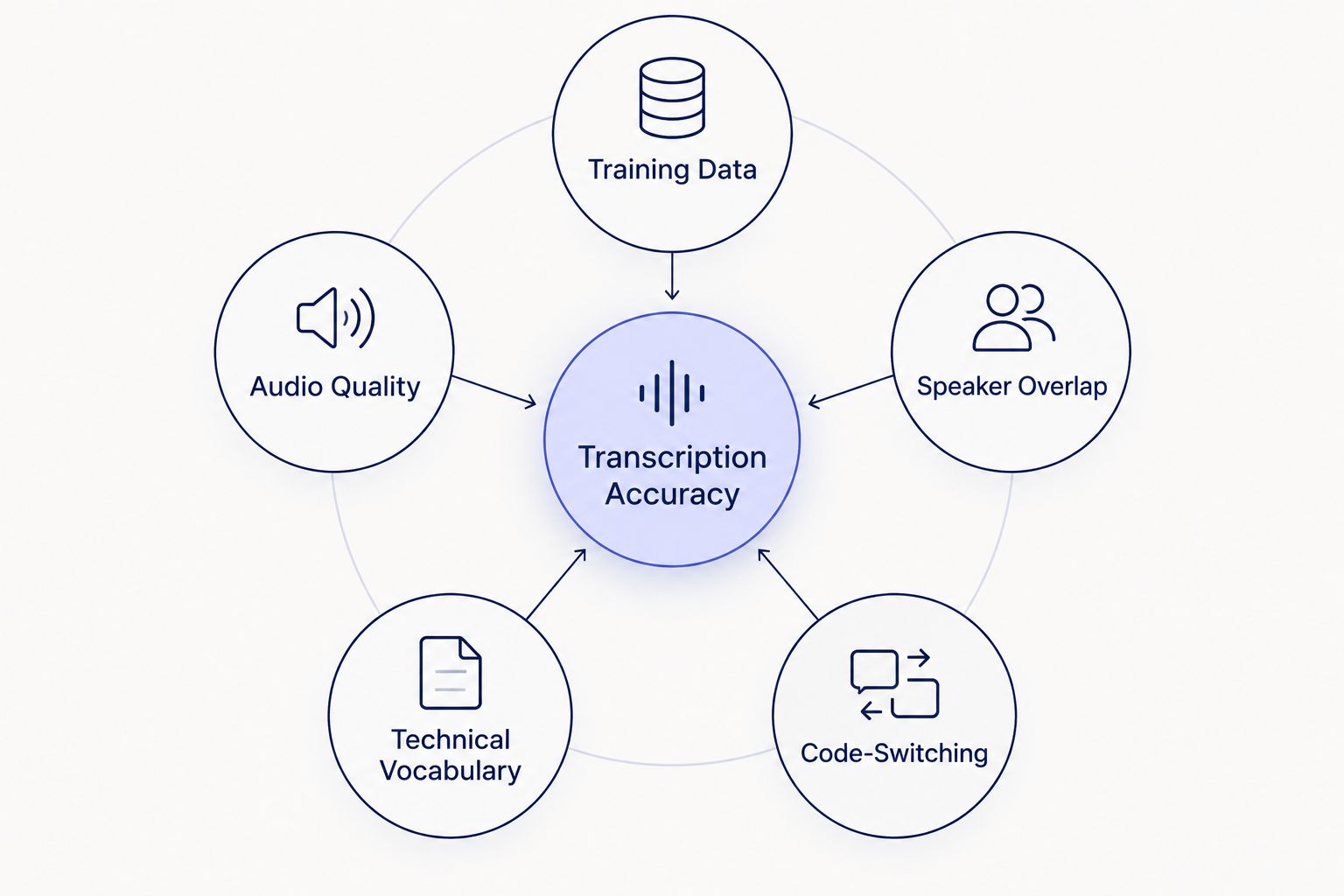
Accent is one input among five — audio quality and speaker overlap compound it.
Does accent affect subtitle timing, not just words?
Yes — accent-related word errors often shift cue boundaries, since ASR timestamps segments based on detected word boundaries, and a misheard word can shorten or lengthen a cue's duration. This shows up as reading-speed (CPS) violations on subtitles even when the transcript text itself looks close to correct.
Which AI transcription tools handle accents best in 2026?
No single ASR engine eliminates the accent gap, so the practical answer is picking a tool with a strong correction layer on top of the transcription step. Comparisons across podcast-focused transcription tools, including the best AI transcription software for podcasters, consistently rank tools by how well their fix-and-QA stage catches what the ASR step misses, not by raw model accuracy alone.
Can you fix accent-related transcription errors after the fact?
Yes — most accent-driven errors are correctable in a subtitle QA pass rather than a full re-transcription. Tools built around a cue editor synced to video, paired with speaker diarization to separate who said what, cut the re-listening time significantly. See how diarization tools stack up in the best speaker diarization software comparison if overlapping accented speakers are your main pain point.
Once the transcript is corrected, guideline formatting (matching Rev, GoTranscript, or a custom client sheet) and translation into one of 70+ target languages both preserve the original timing on each cue, so fixing accent errors once doesn't mean re-timing the whole file for every export. This matters most for creators exporting to platforms with their own subtitle rules — the best subtitle generator tools for YouTube roundup covers the export-format side of that same workflow.
Clean up accented transcripts faster
Run fix-subtitles QA before you deliver, not after a client rejection.
Open VideoText
FAQ
How accurate is AI transcription for accented English?
AI transcription accuracy for accented English is consistently lower than for standard American or British English, with the gap widest on non-native and code-switched speech. Native regional accents like Scottish or Australian English sit closer to standard-accent accuracy than heavily non-native speech.
Is Whisper better than other ASR models for accents?
OpenAI's Whisper model was trained on 680,000 hours of multilingual audio, a broader base than earlier ASR models trained mostly on US English broadcast audio. That wider training set generally reduces — but does not eliminate — accent-driven errors compared to narrower models.
Does a better microphone improve accented transcription accuracy?
Yes — reducing background noise and room echo removes one error source that stacks on top of accent-related phoneme errors. A close, clean mic gives an ASR model a cleaner signal to match against its training data.
Should I use verbatim or clean verbatim for accented speakers?
Clean verbatim, which drops filler words and false starts while keeping the speaker's actual word choices, is usually faster to correct for accented speech than full verbatim. Full verbatim captures every hesitation and repetition, which multiplies correction time when the ASR output already has accent-driven substitutions.
What file formats keep subtitle timing accurate after fixing accent errors?
SRT and VTT both preserve per-cue timestamps, so correcting accent-driven word errors doesn't require re-timing the file. TXT, PDF, and DOCX exports keep the corrected text but drop the timing data entirely.
Can subtitle CPL settings compensate for accent-driven errors?
No — CPL (characters per line) settings control line length and reading speed, not word accuracy. Fixing CPL violations and fixing accent-driven word errors are two separate QA steps, even though both often need attention on the same file.
How many languages support translation for accented transcripts?
Translation on a corrected accented transcript can typically target 70+ languages while keeping the original cue timing intact, so the accent-fix pass only needs to happen once before translating into multiple deliverables.
Does code-switching lower transcription accuracy more than a single accent?
Yes — code-switching between two languages mid-sentence produces the highest error rates of any accent-related pattern, because most ASR models are built for one language at a time and either misread the switched segment or drop it.
One last thing
The biggest accuracy jump in accented-speech transcription over the past few years didn't come from a new accent-specific model — it came from Whisper's decision to train on 680,000 hours of audio pulled from the open web instead of curated broadcast English. Breadth of training data, not accent-specific tuning, closed more of the gap. Going into any 2026 transcription job with a heavy accent, budget your QA time around code-switched segments and cross-talk first — that's where even the best ASR models in wide use still fail the hardest.
Related guides