AI transcription tools produce a full-text draft in minutes, but the draft still needs a review before it reaches a client, a platform, or the public in 2026 — the real question is how much of that review you can skip and for which jobs.
TL;DR
- AI transcription is not accurate enough to skip proofreading for client deliverables, legal, medical, or broadcast subtitles in 2026.
- Clean, single-speaker audio with no jargon is the one case where a light review can replace a full proofread.
- Homophones, speaker mislabeling, and punctuation are the three error types automatic speech recognition (ASR) still misses most often.
- Subtitle QA review flags CPL, CPS, and timing-drift issues automatically, which shortens the manual pass without removing it.
Why this matters
Editors and freelance transcriptionists lose paid hours to two extremes: proofreading drafts that didn't need it, and shipping drafts that did. Both cost money. ASR engines in 2026 handle clean, single-voice audio well, but they still fail predictably on cross-talk, accents, technical terms, and subtitle timing.
The fix isn't "trust the AI" or "proofread everything." It's knowing which content types tolerate a light pass and which ones require full human review before delivery. VideoText is built around that split — automated transcription and subtitle generation up front, then a dedicated QA layer for the parts ASR gets wrong.
Is AI transcription accurate enough to skip proofreading?
It depends on the audio and the audience. The table below breaks down where a light review is defensible and where full proofreading stays mandatory.
| Content type |
Typical AI errors |
Skip proofreading? |
| Single-speaker lecture or webinar, clean audio |
Occasional homophone, leftover filler word |
Often, for internal notes only |
| Multi-speaker podcast or interview |
Speaker mislabeling, cross-talk gaps, misheard names |
No |
| Legal, medical, or technical content |
Misheard terminology, dropped negations ("not" vs nothing) |
No |
| Client-facing or streaming subtitles |
Timing drift, CPL/CPS violations, missing punctuation |
No |
The pattern holds across formats: the more speakers, jargon, or downstream visibility a transcript has, the less you can skip.
Clean, single-speaker audio: a light review can replace a full proofread
A single voice, a quiet room, and everyday vocabulary is the only condition where skipping a full proofread is a reasonable call in 2026. Word error rate (WER) drops sharply on this kind of audio because ASR models trained on large speech datasets handle isolated, clear speech close to their training distribution. Skim for names, numbers, and acronyms — those are the categories that still get misheard even on good audio — and move on.
Multi-speaker or noisy audio: proofreading stays mandatory
Two or more speakers talking over each other, background noise, or a phone-call recording all push error rates up, and proofreading stays mandatory. Diarization — the process of detecting and labeling who spoke when — is the weak point. Overlapping speech gets attributed to the wrong person or merged into one speaker's line, which changes the meaning of a quote even when every word is transcribed correctly. Podcast and interview transcripts fall in this bucket almost every time; a podcast-specific transcription workflow still needs a human diarization check before delivery.
Client deliverables and streaming subtitles: proofreading is non-negotiable
Anything shipped to a client, uploaded to YouTube, or delivered as broadcast or streaming subtitles needs full human review — no exceptions in 2026. Subtitles carry two accuracy layers a plain transcript doesn't: characters per line (CPL) and reading speed (CPS), plus timing that has to track scene cuts and speaker changes. AI-generated captions routinely violate CPL limits or drift out of sync by a few frames, both invisible in the raw text but obvious the moment someone watches the video. A subtitle generator built for YouTube delivery still needs a QA pass against those specs before publishing.
Why AI transcription accuracy varies
WER isn't a fixed number — it moves with the audio and the content. The factors that push error rates up the most:
- Background noise and room acoustics — echo, HVAC hum, and street noise all raise misrecognition rates
- Speaker overlap and cross-talk — interruptions and simultaneous speech confuse diarization
- Accents and dialects — models trained mostly on standard accents perform worse on regional or non-native speech
- Technical jargon and proper nouns — medical terms, brand names, and industry acronyms aren't in general-purpose vocabularies
- Number of speakers — diarization accuracy drops as speaker count rises, especially past four or five voices
- Microphone distance and setup — a laptop mic across a room performs worse than a lav mic, regardless of the model
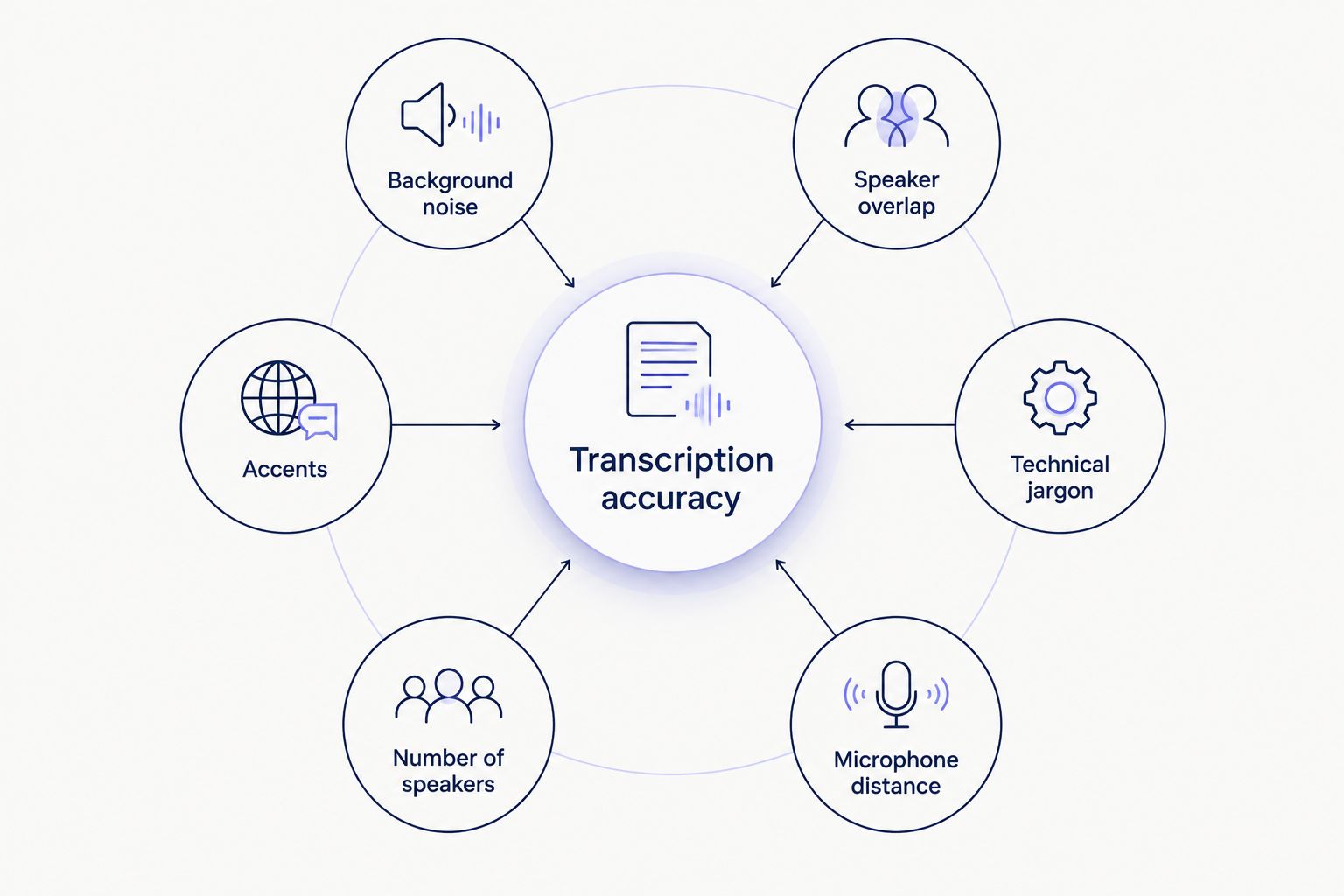
Speaker overlap and jargon are the two factors proofreaders should check first.
Diarization accuracy specifically is worth checking against your source tool before you trust a multi-speaker draft. A speaker diarization comparison is the fastest way to see which tools handle three-plus speakers without a manual relabel.
What is a good word error rate (WER) for AI transcription in 2026?
WER measures the percentage of words an ASR engine gets wrong compared to a human-verified reference. There's no single "good" number that applies everywhere — a WER acceptable for a quick internal summary is not acceptable for a legal deposition, where a single misheard word can change a fact on the record. Treat any published WER figure as a best-case number measured on clean, single-speaker audio, not a guarantee for your file.
Does subtitle accuracy differ from transcript accuracy?
Yes — subtitle accuracy adds timing and formatting on top of word accuracy. A transcript can be word-perfect and still fail as a subtitle file if lines run past CPL limits, cues overlap, or reading speed (CPS) is too fast for a viewer to follow. Subtitle QA checks both layers; transcript proofreading checks only the words.
Can AI transcription catch its own timing errors?
No, not reliably — ASR models generate timestamps as a byproduct of speech detection, not as a validated output. Timing drift, overlapping cues, and scene-cut mismatches typically need a rules-based or human check layered on top of the raw ASR output before subtitles go out the door.
When a transcript clears the multi-speaker or client-facing bar above, the proofreading pass is really a QA pass: check speaker labels, check terminology, check subtitle timing against CPL and CPS limits. That's the workflow VideoText's subtitle QA review is built around — an in-browser cue editor synced to the video that flags overlaps, drift, and reading-speed issues instead of asking an editor to catch them by eye.
Run a QA pass before delivery
Check CPL, CPS, and timing drift before sending subtitles to a client.
Try VideoText
FAQ
Is AI transcription accurate enough for client deliverables in 2026?
No, AI transcription alone is not accurate enough for client deliverables in 2026. Client-facing transcripts and subtitles still need a human QA pass for speaker labels, terminology, and timing.
What is word error rate (WER) and why does it matter?
WER is the percentage of words an ASR engine transcribes incorrectly compared to a verified reference. It matters because it's the closest thing to a comparable accuracy metric across tools, but it varies heavily by audio quality and speaker count.
Can I skip proofreading for a single-speaker podcast transcript?
Only if it's for internal use and the audio is clean with one speaker. Anything going to a client or public platform still needs a review pass, even single-speaker content.
How does speaker diarization affect transcript accuracy?
Diarization labels who spoke when, and it's the step most likely to fail on overlapping speech or more than three or four speakers. A mislabeled speaker changes who said what, even if every word is transcribed correctly.
What's the difference between verbatim and clean verbatim transcription?
Verbatim transcription keeps every filler word, false start, and repetition exactly as spoken. Clean verbatim keeps the speaker's meaning but removes fillers like "um" and false starts for readability.
Do streaming platforms require human-reviewed subtitles?
Most streaming and broadcast delivery specs require subtitles that pass CPL, CPS, and timing checks that raw AI output doesn't reliably meet. A human or rules-based QA pass is standard before delivery.
How much time does proofreading AI transcripts actually take?
It depends on speaker count and audio quality, but a light review of clean single-speaker audio takes far less time than a full proofread of multi-speaker or noisy audio. The time savings from AI transcription come from the first draft, not from skipping review.
One last thing
The error type that costs editors the most time isn't a misheard word — it's a mislabeled speaker in a long interview, because fixing it means re-listening to entire stretches of audio to confirm who said what. Check diarization first on any multi-speaker file, before you touch grammar or punctuation.
Related guides