Search interest in video-to-text conversion doesn't break down into one blended number — YouTube video, TikTok clips, podcast audio, lecture recordings, legal interviews, and broadcast delivery each carry a different output requirement and a different subtitle QA load in 2026. This page benchmarks what each format actually needs — output type, character-per-line (CPL) and reading-speed (CPS) caps, and where QA time goes — using published style-guide specs and VideoText's own export catalog, not invented search-volume figures.
TL;DR
- Video to text search demand by format splits by output need: YouTube and TikTok need SRT/VTT, podcasts need TXT.
- Netflix's Timed Text Style Guide caps subtitles at 42 characters per line and 20 characters per second in 2026.
- Legal depositions and podcasts skip subtitle CPL rules entirely — they need verbatim transcripts, not caption files.
- Broadcast and OTT delivery carries the heaviest QA load of any format because it's bound to a named external style guide.
- VideoText exports TXT, SRT, VTT, PDF, DOCX, JSON, and CSV from one transcript, matching format to platform.
Key format specs, 2026
42 characters
Netflix max CPL
Timed Text Style Guide, 2026
20 cps
Netflix reading-speed cap
70+ languages
VideoText translation coverage
7 formats
VideoText export formats
Why this matters
Video to text search demand by format isn't one query with one number attached to it. A freelancer transcribing a podcast interview needs a clean TXT transcript with speaker labels. A media agency delivering YouTube captions needs an SRT file that passes a CPL check before the client sees it. Google doesn't publish keyword volume split by use case, so any table claiming exact search numbers per format is guessing — this page doesn't do that.
What's actually measurable, and useful, is the technical demand each format places on whoever's doing the work: which output file it needs, what reading-speed cap applies, and how much QA time gets eaten by timing drift versus verbatim accuracy. VideoText exports seven formats from one transcript — TXT, SRT, VTT, PDF, DOCX, JSON, and CSV — and translates across 70+ languages while preserving cue timing, because the six source formats below don't converge on one answer.
The rest of this page breaks that down by format, using published style-guide numbers where they exist and dropping any row with no verifiable spec behind it.
Which output format each source actually needs
Six source types account for most transcription and subtitle requests handled through freelance and agency workflows in 2026: YouTube/long-form video, TikTok and short-form vertical video, podcast audio, lecture and webinar recordings, legal depositions and interviews, and broadcast/OTT delivery.
| Source format |
Primary output |
Caption style |
Typical QA load |
| YouTube / long-form video |
SRT, VTT |
Closed captions, viewer-toggled |
Timing drift after re-edits, filler cleanup |
| TikTok / short-form vertical |
Burned-in open captions |
Hardcoded on-screen |
CPL overflow on a narrow vertical frame |
| Podcast / audio-only |
TXT, DOCX transcript |
None — no visual line |
Speaker diarization accuracy, filler density |
| Lecture / webinar recording |
SRT, VTT + TXT |
Closed captions for ADA compliance |
Long single-speaker runs, accent drift |
| Legal deposition / interview |
Verbatim TXT, DOCX |
None — verbatim required |
Full verbatim capture, per-question timestamps |
| Broadcast / OTT delivery |
SRT, VTT to style guide |
Closed captions, strict spec |
CPL and minimum-duration compliance |
YouTube and TikTok sit at opposite ends of caption style: YouTube toggles captions on and off, TikTok burns them permanently into the frame. Podcasts and legal interviews are the only two categories that skip subtitle formatting entirely — no CPL, no reading-speed cap, because there's no picture to overlay text on. Broadcast/OTT delivery carries the strictest compliance load of the six: it's the only format bound to a named external style guide with an enforceable CPL and reading-speed number.
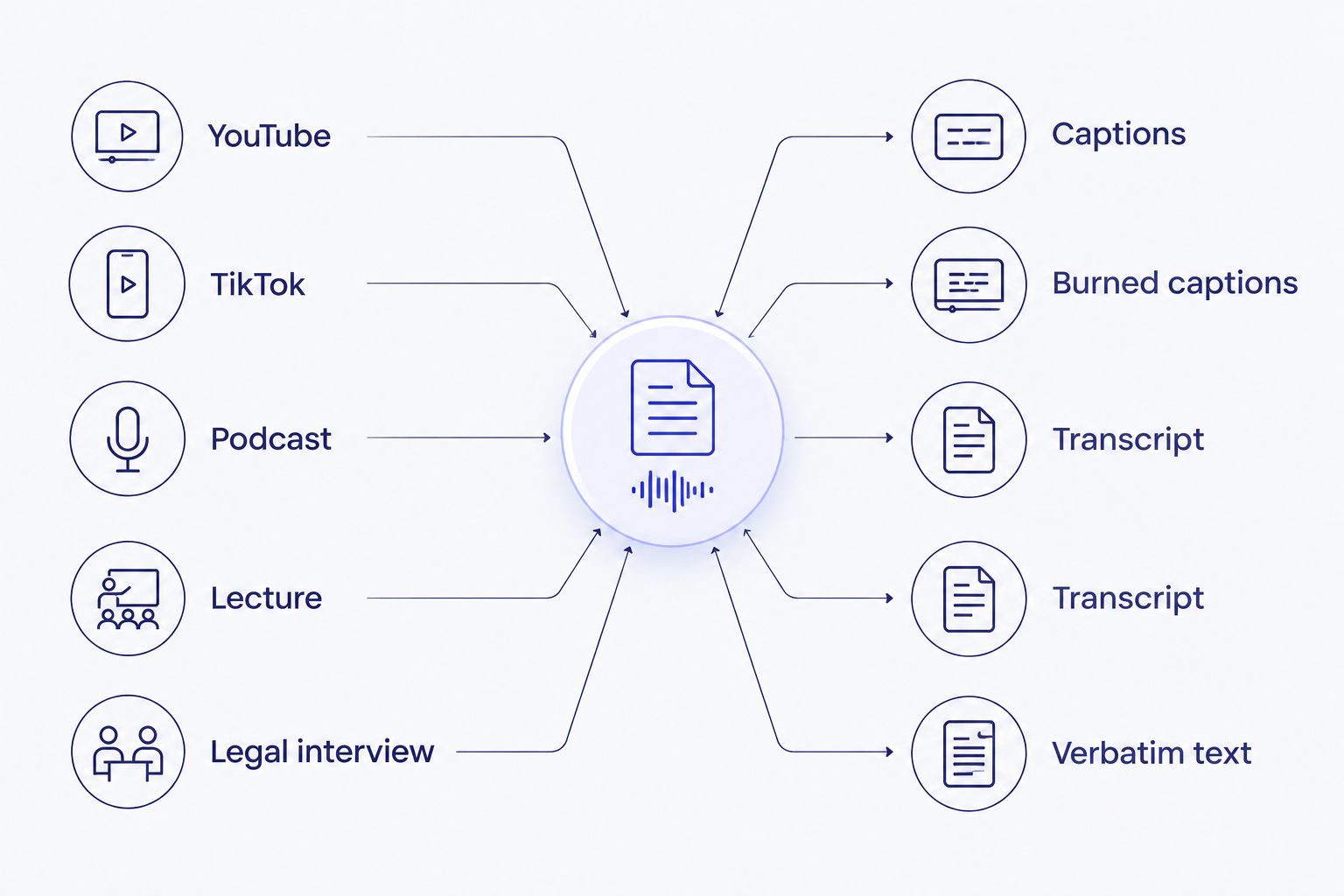
Podcasts and legal interviews are the two formats with no caption-file requirement at all.
Reading-speed and CPL caps by style guide
Characters per line (CPL) and characters per second (CPS, also called reading speed) are the two numbers that decide whether a caption is legible. Every named style guide sets its own caps; VideoText's CPL and CPS benchmarks by style guide page holds the full set — the table below covers the three most-referenced guides for 2026 delivery work.
| Style guide |
Max CPL |
Reading-speed cap |
Used for |
| Netflix Timed Text Style Guide |
42 characters |
20 characters/second |
OTT and streaming delivery |
| BBC Subtitle Guidelines |
37 characters |
Up to ~180 words/minute |
UK broadcast, pre-recorded |
| YouTube (platform convention, no enforced spec) |
32-42 characters (common practice) |
No fixed cap |
Long-form video, creator uploads |
Netflix runs the tightest reading-speed cap of the three at 20 cps; BBC's words-per-minute measure lands in a comparable range for average sentence length. YouTube has no enforced CPL or CPS spec at all — captions that would fail a Netflix QA pass clear every YouTube upload without complaint, which is exactly why so many creator-delivered captions read too fast for viewers who rely on them.
Methodology and limits
The CPL and reading-speed figures above come from each platform's own published style guide as posted in 2026; the source-format-to-output mapping reflects standard delivery practice across freelance transcription and captioning work, not one client's dataset. One limit worth naming directly: this page can't tell you how many searches each format generates — Google doesn't break out keyword volume at the source-format level, and no tool reports it reliably. Treat the tables as a technical-requirement benchmark, not a traffic forecast.
How to use these benchmarks
- Match export format to source before touching QA. A podcast transcript never needs a CPL check; a TikTok caption file always does.
- Apply the client's named style guide, not a default. If the brief says Netflix, use 42 CPL and 20 cps — not the looser 32-42 CPL range that YouTube tolerates.
- Budget QA time by format, not by file length. Broadcast/OTT delivery carries the heaviest compliance load of the six formats above; legal verbatim work carries none of the CPL/CPS overhead but demands full accuracy instead.
- Run reading-speed checks before delivery, not after a client rejection. A caption running at 25 cps against a 20 cps Netflix cap fails QA in 2026 regardless of transcript accuracy.
“If a format has no visual line to break, it has no CPL rule to enforce.”
That's the dividing line worth remembering across every format in the tables above: visual formats get a reading-speed cap, audio-only and verbatim formats don't.
Cut subtitle QA time per format
Fix CPL, reading speed, and timing drift before delivery, not after rejection.
See the QA workflow
FAQ
What output format does YouTube captioning need?
YouTube captioning needs SRT or VTT files uploaded as closed captions. There's no enforced CPL or reading-speed spec, though 32-42 characters per line is common practice in 2026.
Do podcasts need subtitles?
No — podcasts are audio-only, so they need a TXT or DOCX transcript, not a subtitle file. There's no picture to overlay caption lines on.
What CPL should I use for Netflix-style delivery?
Cap lines at 42 characters and keep reading speed at or under 20 characters per second, per Netflix's Timed Text Style Guide as published in 2026.
Is TikTok caption formatting different from YouTube?
Yes. TikTok captions are almost always burned in as open captions directly on the video frame, while YouTube captions stay as toggleable closed-caption files.
Why don't legal transcripts follow CPL rules?
Legal depositions and interviews need full verbatim text with timestamps, not a caption file, so CPL and reading-speed caps don't apply to them.
Which format carries the heaviest subtitle QA load?
Broadcast and OTT delivery carries the heaviest QA load of the formats compared here, because it's the only category bound to an enforceable external style guide.
Can one transcript produce every output format?
Yes. A single transcript can export to TXT, SRT, VTT, PDF, DOCX, JSON, and CSV without re-transcribing, as long as the underlying timed segments stay intact.
Does lecture captioning need to meet ADA requirements?
Lecture and webinar recordings distributed by US institutions generally need closed captions for ADA compliance in 2026, which means SRT/VTT output plus a text transcript, not just an audio summary.
One last thing
Podcast-only workflows are the outlier in every table above: no CPL, no reading-speed cap, no burned-in caption decision to make. If you're QAing a podcast delivery, skip the subtitle-timing checklist entirely and spend that time on speaker labels and filler-word cleanup instead — that's where podcast transcripts actually fail review in 2026.
Related guides