Professional video transcription cost depends on which pricing model you pick, not on a single market rate — per-minute human transcription, flat-rate AI subscriptions, and hybrid workflows that combine both all price the same audio minute differently. This breaks down what actually drives cost up or down in 2026, from turnaround time to speaker count to verbatim style.
TL;DR
- Professional video transcription cost splits into two models: per-minute human billing and subscription-based AI transcription.
- Turnaround speed, speaker count, and verbatim style push human transcription rates up the most.
- AI transcription tools like VideoText remove the per-minute labor cost but still need manual QA before delivery.
- A hybrid workflow — AI draft plus manual cleanup — is the standard cost-control move for 2026 subtitle teams.
Why this matters
Most freelancers and agencies quoting transcription work default to whatever rate a client mentions first, without checking which cost driver actually caused it. That's how a simple two-speaker interview ends up quoted at the same rate as a six-speaker roundtable with crosstalk. Knowing the drivers — not a single number — is what lets you quote accurately and defend the quote.
VideoText runs the AI side of this equation: automatic speech recognition (ASR) turns raw video or audio into a timed transcript in minutes, and the same pipeline outputs SRT/VTT subtitles, speaker labels, and a summary with chapters. The manual QA layer — fixing timing drift, checking CPL, formatting to a client's style guide — is where cost still lives even after AI transcription.
How much does professional video transcription cost in 2026?
There's no single answer because there are three distinct pricing models in play, and each one bills a different unit of work.
| Pricing model |
Billed by |
Typical turnaround |
Best for |
Verdict |
| Human transcription service |
Per audio minute |
Standard (multi-day) or rush |
Legal, medical, compliance-grade verbatim |
Use for accuracy-critical, low-volume jobs |
| AI transcription tool |
Subscription tier, not per-minute |
Minutes |
High-volume podcast, video, and content teams |
Use when volume makes per-minute billing expensive |
| Hybrid (AI draft + manual QA) |
Subscription plus editor time |
Same-day |
Client-ready subtitles and transcripts at scale |
Best for teams balancing speed and accuracy |
Human transcription services — Rev, GoTranscript, Scribie, and independent freelance transcriptionists — bill per audio minute, not per hour of labor. A rush request (same-day or next-day) adds a surcharge on top of the base per-minute rate, and full verbatim costs more to produce than clean verbatim because it takes longer to type, check, and format.
AI transcription tools bill differently. VideoText and comparable platforms charge a subscription tier instead of a per-minute rate, which is why cost per minute of audio drops sharply once volume goes up. The tradeoff: ASR output still needs a manual QA pass before it's client-ready.
Human transcription: what drives the per-minute rate
Full verbatim transcription — capturing every "um," false start, and non-speech sound — takes a transcriptionist longer to produce than clean verbatim, which drops fillers and false starts while keeping the speaker's actual words. Rush turnaround, poor audio quality, and heavy accents all add time on top of the base rate, and time is what per-minute billing charges for.
AI transcription: what the subscription actually buys
A subscription-based AI transcription tool charges for processing capacity, not per-minute output. VideoText's pipeline runs ASR transcription with timed segments, detects and labels speakers through diarization, and generates an AI summary with timestamped chapters in the same pass. Translation covers 70+ languages with cue timing preserved on the subtitles, which matters because a manual translation pass on a per-minute human model would multiply cost, not just add to it.
Hybrid workflow: where most subtitle teams actually land
Few production teams pick a single model. The standard 2026 workflow runs AI transcription first, then pays a human editor — freelance or in-house — to fix what ASR gets wrong: subtitle drift, characters-per-line (CPL) violations, reading-speed (CPS) issues, and formatting to a specific client's style guide. VideoText's fix-subtitles and QA review tools target exactly this step, catching overlaps, gaps, and scene-cut spans in-browser instead of frame-by-frame in a video editor.
Compare AI transcription tools
See how ASR transcription, speaker diarization, and QA tools stack up for 2026 workflows.
See VideoText features
Why transcription cost varies
- Turnaround time — rush jobs (same-day or next-day) carry a surcharge over standard multi-day turnaround on human transcription.
- Verbatim type — full verbatim (fillers, false starts, non-speech sounds included) takes longer to produce than clean verbatim.
- Speaker count — multi-speaker audio needs diarization and speaker labeling, which adds QA time regardless of pricing model.
- Audio quality — background noise, overlapping speech, and heavy accents raise ASR error rates and the manual correction time that follows.
- Language and translation — non-English audio or a translation pass into another language adds a step; VideoText's translation covers 70+ languages with cue timing preserved.
- Volume — batch processing changes the per-file cost math because files run through a queue instead of one at a time.
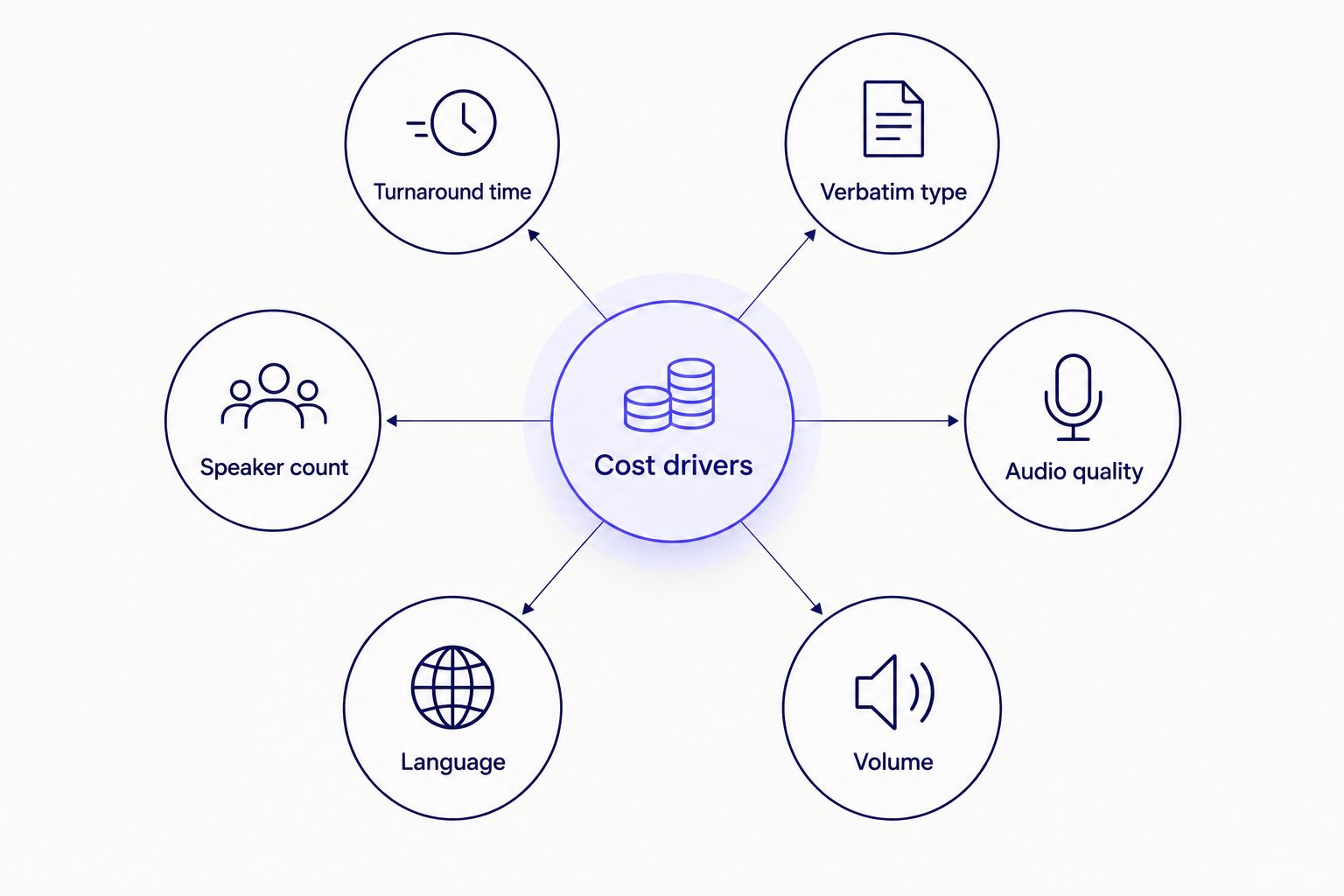
Cost swings on these six factors, not on a single per-minute rate.
“A two-speaker interview and a six-speaker roundtable are never the same quote, even at the same audio length.”
Is AI transcription cheaper than human transcription?
AI transcription is generally cheaper per minute of audio than professional human transcription because it replaces per-minute labor with a flat subscription tier. The gap narrows once a human QA pass is added on top of the AI draft to hit client-ready accuracy, which is the real cost most teams pay in 2026.
Does rush turnaround increase transcription cost?
Rush turnaround increases cost on human transcription services because the surcharge sits on top of the base per-minute rate for same-day or next-day delivery. AI transcription tools process in minutes regardless of rush status, so the turnaround penalty mostly disappears — the cost that remains is the manual QA step before delivery.
What's the difference between verbatim and clean verbatim pricing?
Full verbatim transcription costs more than clean verbatim because it captures every filler word, false start, and non-speech sound, which takes longer to type and verify. Clean verbatim keeps the speaker's actual words but drops the fillers, which is why most client-ready deliverables in 2026 default to clean verbatim unless the use case (legal, research) specifically requires full verbatim.
FAQ
How much does professional video transcription cost in 2026?
Cost depends on the pricing model: human transcription services bill per audio minute plus rush surcharges, while AI transcription tools bill by subscription tier instead. The real cost driver in 2026 is the manual QA pass needed to make either output client-ready.
Is AI transcription accurate enough to skip human review?
AI transcription (ASR) output typically still needs a manual QA pass to catch speaker misattribution, timing drift, and formatting errors before delivery. Skipping review works for internal drafts, not for client-facing transcripts or subtitles.
What's the difference between a transcript and subtitles?
A transcript is a text record of speech with no timing requirement, while subtitles are timed text cues synced to video with limits on characters per line (CPL) and reading speed (CPS). Subtitle production takes more QA time than a plain transcript because of those timing constraints.
Does speaker count affect transcription cost?
Yes, multi-speaker audio adds cost because it requires diarization — detecting and labeling who's speaking — which takes more QA time than single-speaker audio regardless of pricing model.
Do translated subtitles cost more than the original transcript?
Translating subtitles into another language adds a distinct step beyond transcription, since cue timing has to be preserved across the translated text. VideoText's translation feature covers 70+ languages while keeping the original cue timing intact.
What is CPL and why does it affect subtitle QA time?
CPL stands for characters per line, a limit on how much text fits on one subtitle cue so it stays readable at normal reading speed. Fixing CPL violations after AI transcription is one of the main manual QA tasks that adds time to subtitle delivery.
Is batch processing cheaper per file than processing one file at a time?
Batch processing changes the cost math because files run through a queue instead of individually, which is why high-volume podcast and video teams lean on AI transcription tools with batch support instead of per-file human transcription.
One last thing
Netflix's public Timed Text Style Guide caps subtitle lines at 42 characters per line (CPL) and sets reading speed around 17-20 characters per second (CPS) depending on content type — specs that most client style guides quietly mirror even when they don't cite Netflix directly. If a transcript or subtitle file blows past those limits, the QA time to fix it (not the original transcription) is where the real cost hides. Check CPL and reading speed before you quote a job, not after you deliver it.
Related guides