Adding and syncing subtitles to a video takes about 4 to 10 hours of manual work per hour of footage in 2026, based on the multiplier captioning services have used as a work estimate for years. Automatic speech recognition (ASR) cuts the raw-caption step to a matter of minutes, but that draft still needs a manual QA pass for timing drift, overlaps, and characters-per-line (CPL) compliance before it's client-ready — the part most people forget to budget for.
TL;DR
- Manual subtitle syncing runs 4 to 10 hours per hour of video in 2026, per the standard captioning-industry estimate.
- ASR generates a raw subtitle file in minutes, but drift, overlaps, and CPL/CPS still need a manual review pass.
- A hybrid workflow (ASR draft plus manual QA) is the fastest route to a client-ready SRT/VTT file.
- Speaker count, audio quality, and client formatting guidelines are the biggest drivers of how long subtitle QA takes.
- VideoText's subtitle QA review flags overlaps, CPL, CPS, and drift automatically instead of by eye.
Reference numbers
4-10 hours
Manual sync time per video hour
Standard captioning-industry estimate
70+ languages
Subtitle translation coverage
Why this matters
Freelance transcriptionists and subtitle editors bill by the hour or the job, and subtitle syncing is the step that eats the most unpaid time. A client who thinks "add subtitles" means five minutes of software work doesn't know that timing, line breaks, and CPL compliance are separate jobs from getting words on screen. VideoText exists specifically to shrink the gap between a rough ASR draft and a file that passes QA the first time.
That gap is where the 4-to-10-hour manual estimate comes from — it's not the transcription itself, it's the frame-by-frame timing and the guideline checks layered on top of it.
How long does it take to add and sync subtitles to a video?
The answer splits into three workflows, and each one has a different time cost for the same hour of footage:
| Method |
What it produces |
Time cost for 1 hour of video |
| Full manual transcription + syncing |
Timed cues, line breaks, speaker labels, all by hand |
4 to 10 hours |
| ASR automatic captions only |
Raw SRT/VTT, unreviewed timing |
Minutes, not hours |
| ASR draft + manual QA pass |
Corrected drift, CPL/CPS fixed, formatted to guideline |
A fraction of the manual estimate |
The manual number (4 to 10 hours) comes from the range captioning services have quoted for years as a planning estimate — it holds up in 2026 because the bottleneck is still human attention to timing, not typing speed.
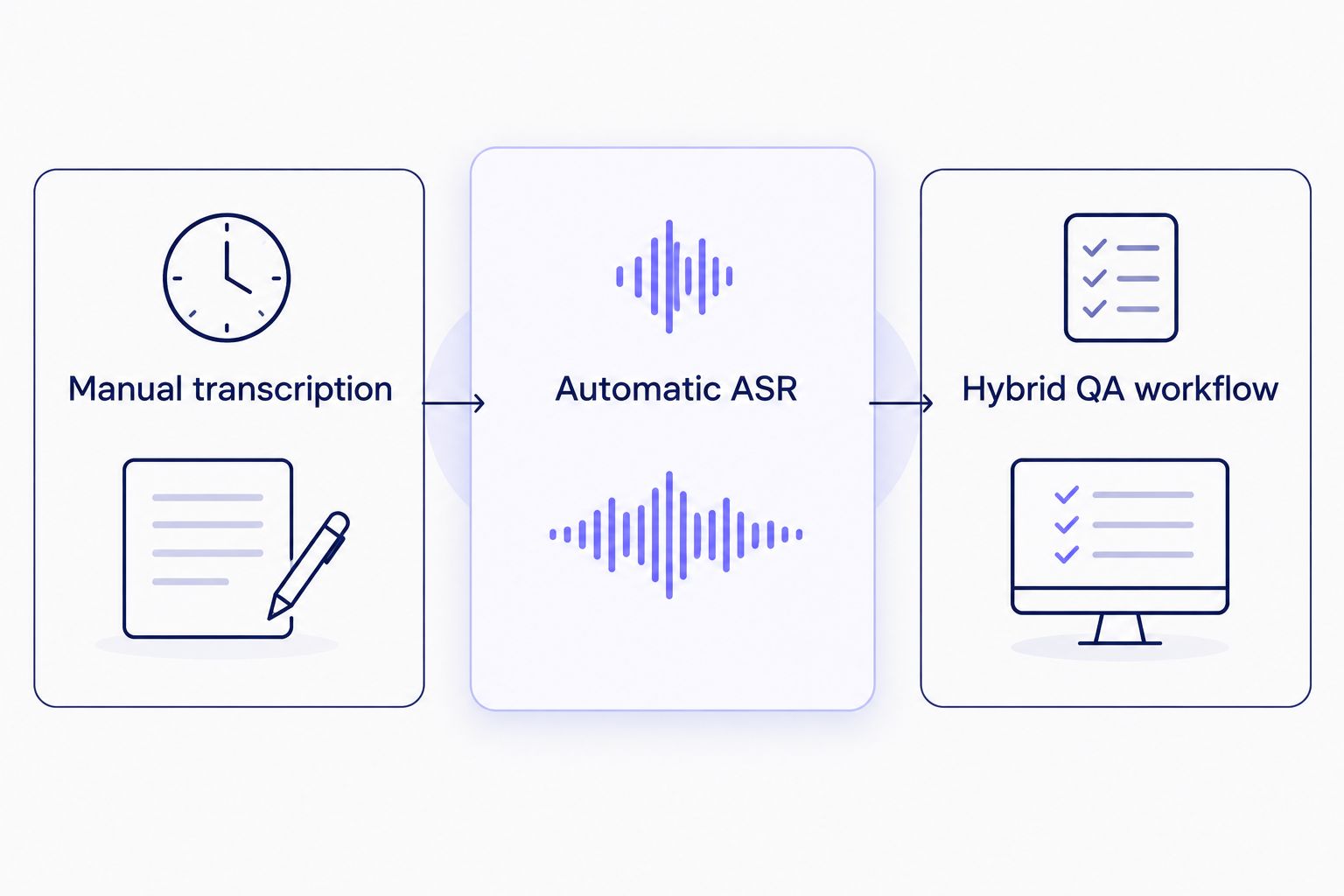
The hybrid workflow keeps the speed of automatic captions and adds the accuracy check manual work provides.
Manual transcription and subtitle syncing: 4 to 10 hours per video hour
A transcriptionist working by hand types the audio, breaks it into cues, sets in/out timecodes, and checks reading speed line by line. On clean, single-speaker audio, expect the low end of the range. On overlapping speakers, technical vocabulary, or poor audio, expect the high end. Verdict: use manual syncing only when the client contract requires full human review of every cue.
Automatic subtitle generation (ASR): minutes, not hours
ASR converts speech to a timed transcript automatically, then exports it as SRT or VTT. This step is fast — the bottleneck moves from typing to reviewing. The output is usable as a starting point but is not client-ready on its own: drift accumulates on longer files, and CPL/CPS limits get ignored by default. Verdict: fine for internal drafts or YouTube auto-captions, risky for paid delivery without a review pass.
Hybrid workflow — ASR draft plus manual QA: a fraction of the manual number
This is the workflow most working editors land on in 2026: generate the draft with ASR, then run a QA pass that checks overlaps, CPL, CPS, gaps, and scene-cut spans instead of re-timing every cue from scratch. VideoText's subtitle QA review syncs the cue editor to the video and flags these issues directly, so the manual step shrinks to fixing what's actually broken instead of checking every line. Verdict: the fastest path to a file that passes client guidelines the first time.
Cut subtitle QA time
Run automated checks for drift, CPL, and CPS before delivery.
Try VideoText
Why subtitle syncing time varies
- Number of speakers — diarization and speaker labeling add review time on multi-speaker files; speaker diarization software reduces this by auto-detecting and labeling speakers instead of doing it by ear.
- Audio quality — background noise, cross-talk, and low-bitrate source files slow both manual typing and ASR accuracy, which pushes more errors into the QA step.
- Vocabulary density — technical terms, brand names, and jargon need manual correction regardless of method.
- Client formatting guidelines — Rev, GoTranscript, Scribie, and custom style guides each set different CPL, CPS, and line-break rules, and reformatting to match adds a distinct pass.
- Translation requirements — delivering subtitles in a second language on top of the source-language file adds a translation step; VideoText supports 70+ languages with timing preserved on the translated cues.
- Platform target — subtitle generator tools for YouTube often skip CPL/CPS enforcement entirely, which shifts that check onto the editor if the file is repurposed for broadcast or streaming delivery.
Related questions
How long does it take to sync subtitles frame-by-frame manually?
Frame-by-frame manual syncing falls inside the same 4 to 10 hour per video hour range cited for manual captioning, since precise timing — not typing — is the most time-consuming part of the job in 2026.
Is automatic captioning faster than manual captioning?
Automatic captioning is faster than manual captioning by a wide margin: ASR produces a raw subtitle file in minutes, while manual syncing on the same footage runs 4 to 10 hours per video hour.
How long does subtitle QA take?
Subtitle QA can add hours on top of the 4 to 10 hour manual estimate when overlaps, CPL, CPS, and drift are checked by eye, though automated review tools that flag these issues directly cut that step down significantly.
FAQ
What's a normal turnaround time for subtitle syncing in 2026?
A normal turnaround for manual subtitle syncing is 4 to 10 hours per hour of video in 2026. A hybrid ASR-plus-QA workflow finishes considerably faster because the raw draft is generated automatically.
Does automatic speech recognition make subtitle syncing faster?
Yes — ASR generates a timed transcript in minutes instead of hours, but the output still needs a manual or automated QA pass for drift, overlaps, and CPL/CPS before it's client-ready.
How much time does fixing subtitle drift add to a project?
Drift correction adds review time proportional to how long the video is, since drift compounds over the runtime. Tools that detect drift automatically shorten this step compared to scrubbing the timeline by eye.
Is verbatim transcription slower than clean verbatim for subtitle work?
Full verbatim transcription, which captures every filler and false start, takes longer to produce and to sync than clean verbatim, which drops fillers and false starts before timing the cues.
Do client formatting guidelines change the timeline?
Yes — Rev, GoTranscript, Scribie, and custom client guidelines each set different CPL, CPS, and line-break rules, and reformatting a file to match adds a separate pass beyond basic syncing.
How long does translating subtitles into another language take?
Translating subtitles adds a distinct step on top of source-language syncing, since timing has to be preserved on the translated cues. VideoText supports 70+ languages with cue timing kept intact.
Can batch processing multiple videos save time on subtitle syncing?
Batch processing runs multiple files through the same ASR and QA pipeline at once instead of one at a time, which reduces total turnaround across a project compared to handling each file separately.
What causes subtitle timing drift in the first place?
Timing drift comes from frame-rate mismatches, variable audio speed, and scene cuts that shift cue boundaries out of sync with the dialogue. It compounds over longer runtimes if not corrected early.
One last thing
The part of the 4-to-10-hour estimate that surprises most new subtitle editors isn't the typing — it's the CPL/CPS compliance check. A file can be perfectly transcribed and still fail delivery if lines run too long to read at normal speed. Running an automated CPL/CPS check before the manual review pass, instead of after, is the single change that shortens the 2026 turnaround estimate the most.
Related guides