Transcript QA Process: The 7-Step Review Workflow That Passes Grading
VideoText editorial team · Published · Updated · 2 min read
Transcript QA (searched as transcript qa, qa transcription, and qa process annotation) is a structured sequence — not “read through and fix things.” Platforms like Rev reject on formatting and tags even when words are 97% accurate.
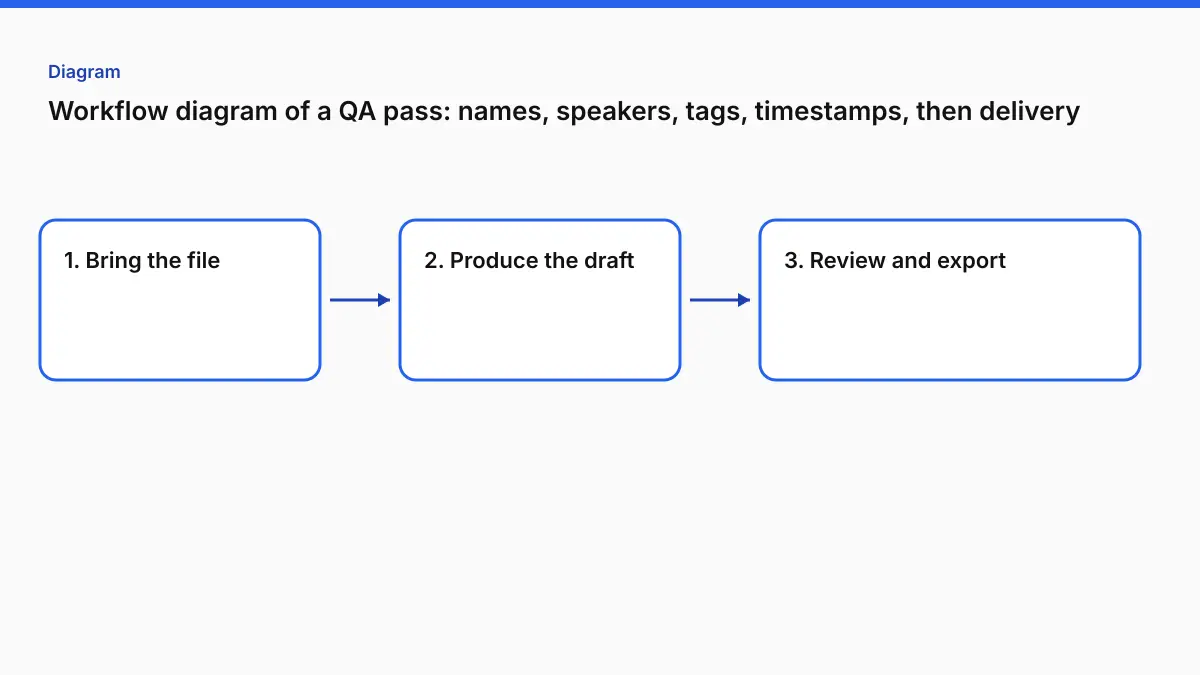
Why a single QA pass fails
A combined read asks you to simultaneously:
- Verify content vs. audio
- Check speaker attribution
- Apply formatting rules
- Validate tags and timestamps
- Fix paragraph structure
Each mode competes for attention. Combined-pass reviewers catch content errors well and formatting errors poorly — yet formatting triggers most marketplace rejections.
Step 1: Client requirements re-read (2 min)
Re-read the job brief before QA starts. Working memory does not survive a 2-hour session.
Confirm: verbatim mode, speaker label format, timestamp rules, glossary terms, inaudible/cross-talk tag specs.
Step 2: Structural integrity (read-only)
- Timestamp coverage at required intervals
- Speaker label consistency (find every variant)
- Word count vs. audio length (~8k–9k words / 60 min)
- Paragraph breaks at speaker changes
Fix bulk structure before line-level review.
Time: 5–10 min / 30 min audio.
Step 3: Tag compliance pass
Search and bulk-fix:
[inaudible]lowercase, bracketed — not[Inaudible],[unclear], or blank[crosstalk]per platform spec- Non-verbals:
[laughs],[applause]— exact format
Graders check tags. This step is fast and high-leverage.
Time: 3–5 min / 30 min audio.
Step 4: Glossary and proper noun pass
List expected proper nouns → search each → batch-correct phonetic substitutions.
AI errors cluster: same wrong word every time. Find-and-replace beats twelve individual listen fixes.
Time: 5–10 min / 30 min audio.
Step 5: Formatting and style compliance
Against the style guide, verify:
- Numbers (spell 1–10, digits 11+)
- Punctuation for clean vs full verbatim
- Speaker label exact format
- Timestamp sample checks across the doc
Time: 8–15 min / 30 min audio.
Step 6: Targeted listen pass
Audio only for:
- Flagged uncertain words
- Unverified proper nouns
- Noisy / cross-talk segments
- Structural red flags from Step 2
Not full linear playback on clean AI output.
Time: 0.4x–0.6x audio length.
Step 7: Final edit pass
Fix all flags in one sweep. Re-read first and last paragraph — endings get the least attention and the most grader scrutiny.
QA time by audio length
| Audio | Steps 1–5 | Listen | Final | Total QA |
|---|---|---|---|---|
| 30 min | 26 min | 12–18 min | 7 min | ~45–51 min |
| 60 min | 40 min | 24–36 min | 12 min | ~76–88 min |
| 90 min | 55 min | 36–54 min | 16 min | ~107–125 min |
Shortcut: eliminate Steps 3 and 5
When Format → Client guidelines normalizes tags and style rules before QA, Steps 3 and 5 become verification (minutes) instead of application (hours).
Pair with Video → Transcript for the highest-accuracy AI draft to QA against.
FAQ
What is transcript QA?
The structured review after transcription: accuracy, formatting, tags, speakers, and client-rule compliance. See also: What is transcript QA? →
Why do AI transcripts fail QA?
Accuracy is often fine; style rules, proper nouns, and speaker labels fail. Why AI transcripts fail QA →
How is QA different from transcript cleanup?
Cleanup is the transcriptionist’s edit pass. QA is the verification layer — often by a second reviewer or grader. Transcript cleanup workflow →
Related tools and guides
- Guideline Format
Apply a client style guide to a transcript before review.
- Fix Transcript
Upload a transcript you already have and correct it before delivery.
- Can you batch process multiple video files for transcription at once?
- Add timestamps to a transcript you already have
- Best AI transcription software for podcasters in 2026
- Clean Verbatim vs Full Verbatim Transcription (Examples + When to Use Each)
- Human QA vs AI QA: Where Errors Actually Happen